

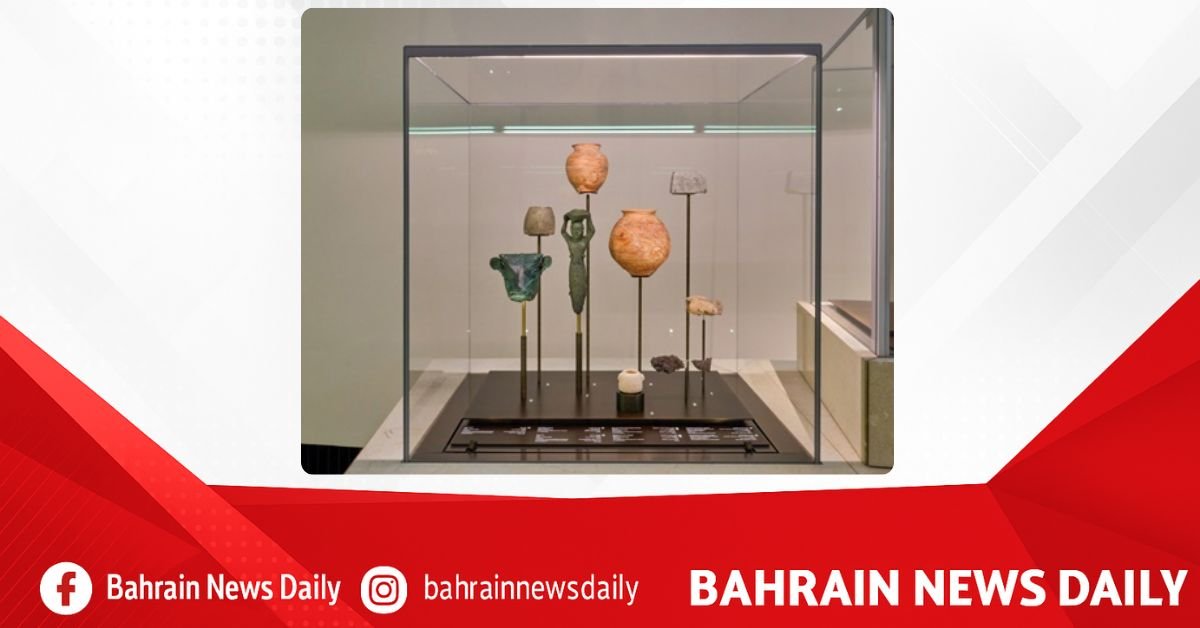
Dec. 13, Manama (BNA): As part of the continuous cultural cooperation between the Kingdom of Bahrain and the United Arab Emirates, the Bahrain Authority for Culture and Antiquities (BACA) took part in the official opening of the Zayed National Museum in Abu Dhabi. Director General of Archaeology Dr. Salman Ahmed Almahari and Director of Museums Haya Ahmed Al Sada represented the Authority.
Bahrain Authority for Culture and Antiquities participates in opening of Zayed National Museum, showcasing 19 artefacts from Dilmun and Tylos periods
In order to showcase Bahrain’s rich history in its exhibition galleries, the Bahrain National Museum loaned 19 famous archeological artifacts from the Dilmun and Tylos civilizations. The collection consists of glass vessels from the Tylos period, pottery, copper and steatite vessels, Dilmun seals, and locally produced Greek silver tetradrachm coins. Given the importance of the Bahrain National Museum and the depth of its holdings, it is the greatest Bahraini loan to a museum organization outside the Kingdom during this time.
The President of BACA, Shaikh Khalifa bin Ahmed bin Abdullah Al Khalifa, emphasized the significance of the cooperation between the two organizations. He pointed out that the quantity of artifacts loaned is the greatest of its kind at this time, highlighting the close cultural links between Bahrain and the United Arab Emirates as well as their shared dedication to showcasing the history and civilizations of the region on a regional and global scale. He continued by saying that Bahrain’s involvement demonstrates its commitment to bolstering the Gulf’s cultural presence and highlighting the importance of museums in conserving cultural heritage, recording local history, and making it available to a worldwide audience.
Earlier this year, the Zayed National Museum and the Bahrain National Museum signed a Memorandum of Understanding to improve cultural and museological collaboration, share knowledge, and create specialized programs in conservation, preventive preservation, visitor services, museum education, and exhibition development. Along with promoting historical and scientific study on the region’s legacy, it also facilitates cooperative exhibitions, the sharing of collections, and the planning of seminars, lectures, and cultural events.

