

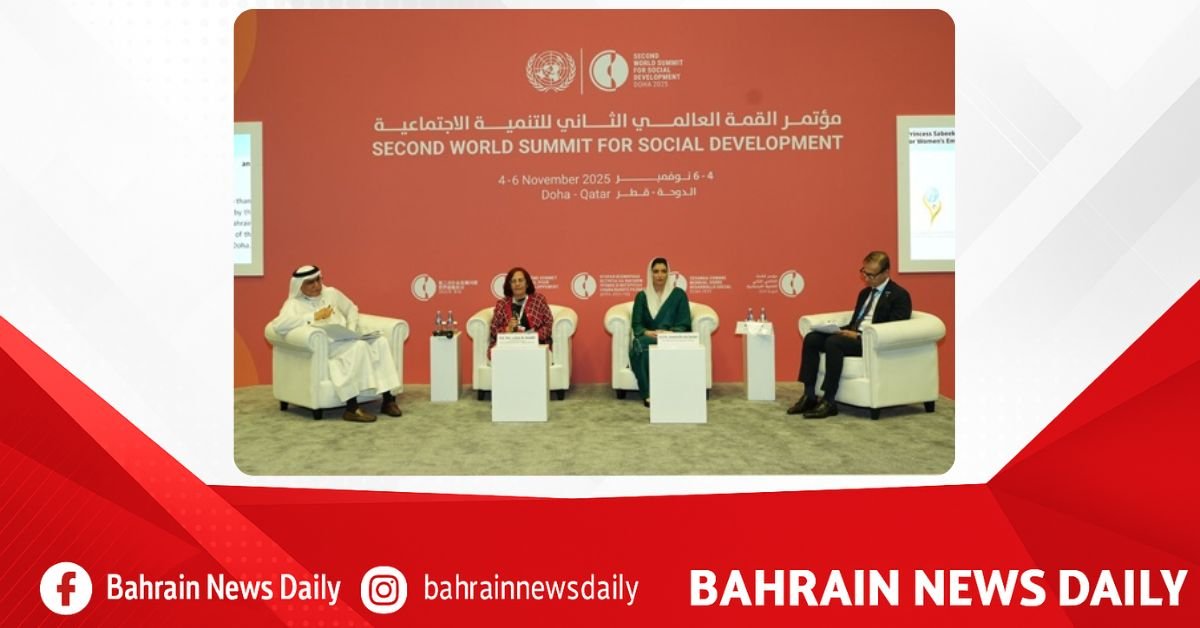
Nov. 6, Doha (BNA): The third edition of the Princess Sabeeka bint Ibrahim Al Khalifa Global Award for Women’s Empowerment was introduced at a side event hosted by the Supreme Council for Women (SCW) and UN Women. The meeting took place from November 4–6 on the fringes of the Second World Summit on Social Development, which was hosted by Doha, Qatar.
SCW, UN Women introduce 3rd Princess Sabeeka bint Ibrahim Global Award at Second World Summit on Social Development
The heads and representatives of national women’s and family affairs mechanisms from the Gulf Cooperation Council (GCC) and several other countries attended the ceremony, as did Aseefa Bhutto Zardari, the First Lady of the Islamic Republic of Pakistan.
The SCW’s Secretary General, Lulwa Saleh Al Awadhi, welcomed the attendees and gave an overview of the award’s history in her opening remarks. The award was adopted by UN Women and formally unveiled in its third edition in March 2025 during the sixty-ninth session of the UN Commission on the Status of Women in New York.
Al Awadhi clarified that the award was initiated by Her Royal Highness Princess Sabeeka bint Ibrahim Al Khalifa, Consort of His Majesty the King and President of the SCW, in response to the award’s national success in elevating Bahraini women’s status and advancing their development. UN Women later embraced the award in 2017 as a global platform to honor significant initiatives that support women’s empowerment and equitable involvement in global development.
Aseefa Bhutto Zardari, the first lady of Pakistan, praised Her Royal Highness Princess Sabeeka for taking the initiative to start a global prize that supports initiatives for women’s empowerment. She emphasized the significance of these programs in expanding women’s roles and attaining opportunity equality. She described Pakistan’s experience in this area and pointed out that women’s empowerment is a basis for sustainable development as well as a question of justice.
Dr. Moez Doraid, a member of the International Jury of the Global Award and UN Women’s Regional Director for the Arab States, gave a presentation detailing the goals, standards, and target audiences of the award as well as the function of the international jury, which consists of academics, senior officials, and women’s affairs specialists. In addition, he evaluated the first and second editions’ winning projects and urged people to participate in the third edition to take advantage of the recognition it provides.
The occasion was also addressed by Dr. Maimoonah Khalil Al Khalil, Secretary General of the Kingdom of Saudi Arabia’s Family Affairs Council. She praised Bahrain’s initiative in establishing the Princess Sabeeka bint Ibrahim Al Khalifa Global Award for Women’s Empowerment, calling it a trailblazing endeavor that inspires global action to support women’s involvement in leadership and decision-making positions. She pointed out that participation from the public, business, and civil society sectors has increased as a result of the award’s shift from a national to a worldwide platform under UN Women’s adoption and international jury oversight.
Such programs, according to Dr. Maimoonah Al Khalil, encourage healthy competition that promotes women’s advancement, showcases successful and repeatable experiences, and promotes information sharing. She emphasized Saudi Arabia’s dedication to promoting participation in the award and highlighting exceptional national accomplishments by pertinent national agencies.

