

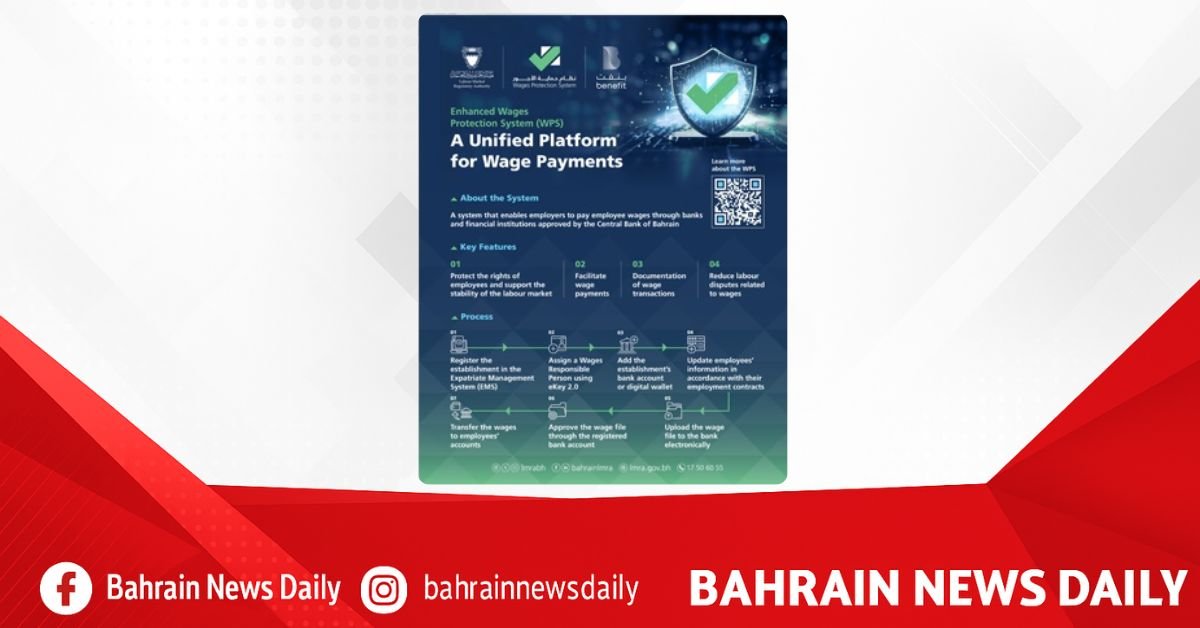
October 21, Manama (BNA): In order to ensure contractual stability in the private sector, the Labour Market Regulatory Authority (LMRA) has introduced an improved version of the salaries Protection System (WPS) that aims to protect the rights of all parties involved in the work process and document the promise to pay workers their salaries on time.
LMRA launches enhanced Wages Protection System
The WPS was developed by the Authority in collaboration with the Central Bank of Bahrain, the Bahrain Electronic Network for Financial Transactions (Benefit), and several private sector partners to meet the needs of the labor market and to allow private sector establishments to facilitate and document wage payments electronically without having to invest in separate financial systems, according to Nibras Talib, the Chief Executive Officer of LMRA and Chairman of the National Committee for Combatting Trafficking in Persons.
He clarified that the safeguarding of national employees’ rights and their stability in a just and secure workplace are top concerns for the improved system. Additionally, it helps national businesses manage their administrative and financial operations, which enhances the effectiveness of human resource management, lessens operating costs, and improves the sustainability of private sector businesses.
In order to strengthen the Kingdom’s standing as a premier workplace founded on efficiency and transparency, the LMRA Chief Executive expressed pride in the partnership with Benefit in providing financial facilities and solutions that allow the private sector to electronically pay wages through approved bank accounts.
The Wages Protection System is one of the strategic priorities for protecting the rights of all parties involved in the labor process, according to Nibras Talib, who also said that the Authority’s dedication to enhancing Bahrain’s standing as a stable and alluring location for capital and investment is reflected in the system’s development.
He went on to say that the system also helps employers, especially those in small and micro businesses, by fostering stable working relationships and improving company reputation. It also lowers wage-related conflicts and speeds up their settlement, which improves job security. He encouraged employees to activate their bank accounts and asked companies to start using the system for electronic wage payments so they may take advantage of its benefits.
In this regard, Nibras Talib praised the banks and financial institutions that took part in the system’s pilot phase for their cooperative efforts, highlighting their ongoing assistance in guaranteeing successful technical alignment and system integration, which helped the banking system be ready prior to its formal launch. He emphasized that this collaboration is a reflection of the successful collaboration between the public and commercial sectors in building the labor sector’s digital infrastructure.
According to Benefit’s CEO, Abdulwahed AlJanahi, the company is proud to have worked with the LMRA as a strategic partner to develop the Wages Protection System. He described it as a significant step in bolstering labor market stability, protecting the rights of all parties involved, and allowing the private sector to implement safe and effective payment systems.
According to him, this collaboration demonstrates Benefit’s steadfast dedication to creating cutting-edge financial solutions in collaboration with governmental and regulatory bodies, supporting national initiatives to solidify Bahrain’s standing as a preeminent regional hub for the defense of labor rights and the uptake of cutting-edge electronic payment technologies.
He went on to say, “We are sure that the improved salaries Protection System will be essential in enabling the electronic transfer of salaries via bank accounts without adding to the workload of employers or necessitating the use of special technologies. Benefit is confident and optimistic about the long-term results of this improved system, which guarantees consistent and transparent wage payments, upholds a professional and accountable work culture, and establishes Bahrain as a leading example of electronic payment systems, all of which will benefit the country’s economy and inspire investor confidence.
Employers in the private sector can use the WPS to pay wages through banks and other financial institutions that have been authorized by the Central Bank of Bahrain. The electronic system was created by the Authority to guarantee accountability, openness, and adherence to labor laws. While the remaining institutions are being integrated in preparation for full deployment in the first quarter of 2026, it has also finished trial procedures to align the systems of a number of banks and financial institutions with the WPS in order to check service quality and efficiency.
Additionally, the Authority has started hosting monthly training and orientation workshops in Arabic and English for private sector employers and human resources staff. The Authority’s website has schedules and information for those who would like to participate.
Additional details can be found at www.lmra.gov.bh or by calling the LMRA Call Center at 17506055.

