

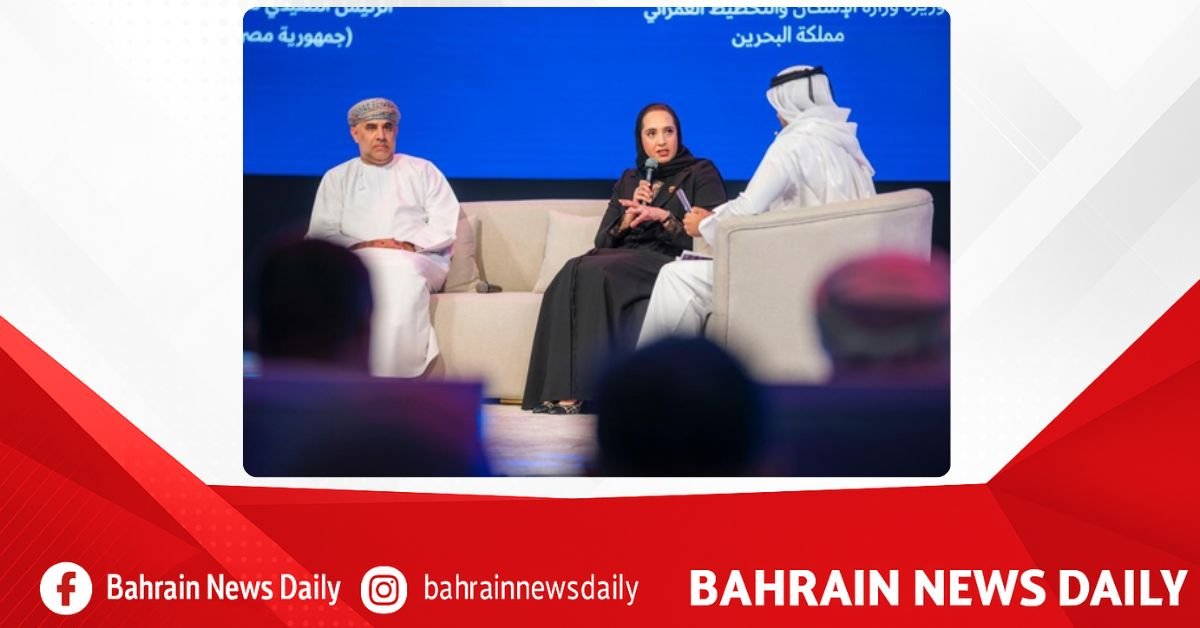
Muscat, Oct. 7 (BNA): The Sultanate of Oman sponsored the Urban Planning, Housing, and Construction Exhibition and Conference in Muscat, which was opened by Amna bint Ahmed Al Rumaihi, Minister of Housing and Urban Planning.
Housing Minister participates in Urban Planning, Housing, and Construction Exhibition and Conference in Muscat
Government representatives, specialists, developers, and financial institutions from all over the GCC come together for the event to share knowledge, exhibit cutting-edge housing and urban planning techniques, look into investment prospects, and fortify alliances.
The minister reaffirmed that the foundation of Bahrain’s housing and urban development plans is sustainability, with the aim of promoting the Kingdom’s overall development. According to her, these plans are intended to raise the standard of living for Bahraini citizens, who are the primary focus of the country’s growth, and to support initiatives and projects in which the private sector is heavily involved.
According to Al Rumaihi, the social housing industry in Bahrain has developed into a cohesive system involving both public and private organizations. She pointed out that through both conventional housing projects and finance programs, the two sectors’ fruitful collaborations in recent years have given Bahraini households access to thousands of housing services. She cited one program that has increased collaboration with the commercial sector as the Government Land Development Rights Programme.
According to the minister, citizens now have more housing options and may acquire homes more rapidly thanks to the involvement of banks, commercial organizations, and real estate firms. She went on to say that this has helped other linked economic sectors thrive as well.
Al Rumaihi pointed out that the field of urban planning and development has made significant strides recently, including the completion of 96 comprehensive development plans that encompass 10% of Bahrain’s entire land area. According to her, the government keeps revising laws in this crucial area, which promotes housing projects, fosters social and economic growth, and creates new chances for urban renewal around the Kingdom.
Alongside Oman’s Minister of Housing and Urban Planning, Dr. Khalfan Al Shuaili, the minister also participated in a ministerial session titled “Sustainable Housing Models in GCC Countries.” She discussed the government’s plans for urban planning and development, such as the Manama Souq Heritage District Project and the Muharraq City Development Project, and Bahrain’s experience expanding housing alternatives through private sector partnerships.
In addition to the conventional building of Bahrain’s five housing cities, the minister claimed that the private sector partnership strategy has been crucial in the expansion of housing services since 2014, supplying more than 27,000 housing units.
More than 21,000 housing loans have been made available under the housing finance scheme, she continued, enabling Bahraini families to buy homes right away and without having to wait for approval. According to her, these findings demonstrate the public’s increasing trust in the financing solutions, which now offer a variety of uses and adjustable payback plans.
Al Rumaihi pointed out that more than 6,000 social housing units have been directly supplied through agreements with real estate developers, including more than 3,000 units in the Deerat Al Oyoun project and more than 2,500 units in Salman City and Al Lawzi. She also mentioned completed projects carried out by Eskan Bank and the Government Land Development Rights Program, including Hoora Sanad in the Southern Governorate, Al Wadi in Al Buhair, Al Naseem in Salman City, and Suheil in Al Lawzi.
By creating new projects that complement government financing programs, private sector businesses are also increasing the total supply of housing, she continued. With plans to build more than 3,000 new housing units in Khalifa City and other projects to accommodate rising demand and provide residents more options, she said this relationship will only get bigger.
Al Rumaihi emphasized that thousands of Bahraini families now have homes thanks to the government’s development of five main housing cities: Salman City, Khalifa City, East Hidd Housing City, Sitra Housing City, and Ramli Housing District. In accordance with Sustainable Development Goal 11 on sustainable cities and communities, she noted, these cities were planned using contemporary urban design principles that enhance quality of life.
The minister emphasized how crucial urban planning is to drawing in capital and fostering economic expansion. The National Strategic Master Plan 2030 of Bahrain, which describes sustainable urban expansion throughout the Kingdom and guarantees that construction satisfies city sustainability requirements, is still being implemented by the Urban Planning and construction Authority, she said.
Al Rumaihi also mentioned Bahrain’s emphasis on urban renewal initiatives that protect cultural heritage and identity, citing the royal orders on the restoration of the Manama Souq Heritage District and historic Muharraq City, both of which have advanced significantly in their initial stages.
In her closing remarks, she said that Bahrain’s attendance at the conference demonstrated its dedication to exchanging experiences with GCC nations and studying global best practices in urban planning and housing. She went on to say that these kinds of gatherings offer great chances to fortify collaboration and create shared ideas for creating more affluent and sustainable communities.

