

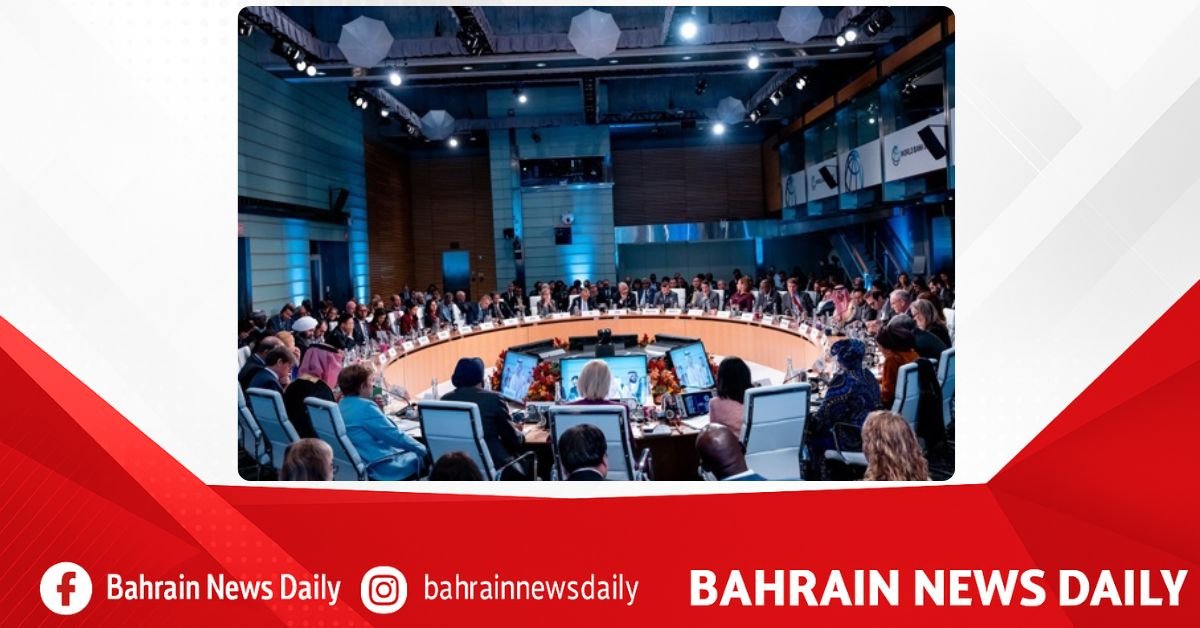
October 17, Washington (BNA): At the 112th meeting of the Development Committee, which is part of the annual meetings of the World Bank Group and the International Monetary Fund (IMF) in Washington, USA, Shaikh Salman bin Khalifa Al Khalifa, Minister of Finance and National Economy, gave a statement on behalf of the Arab Group and the Maldives, represented by the Kingdom of Bahrain.
Finance and National Economy Minister delivers statement on behalf of Arab Group and Maldives before Development Committee
Committee ministers and top representatives from international organizations and institutions convened to talk about common global economic concerns.
According to Shaikh Salman bin Khalifa, a lot of nations are dealing with fundamental issues in their economy that restrict their potential for growth. He pointed out that although women’s employment rates are still low, young people’s need for jobs is still rising. He went on to say that ongoing educational poverty poses a threat to producing a generation devoid of chances and skills, adding that these difficulties have been made worse by geopolitical unrest in a number of areas.
The minister praised the United States and the Arab Republic of Egypt’s efforts to ensure the Sharm El Sheikh Peace Summit was a success and emphasized how the Kingdom of Bahrain valued the role of the United States of America, under the leadership of His Excellency President Donald Trump, in promoting peace. According to him, the battle in Gaza is coming to a conclusion, which is a big step in securing security and stability in the region.
Shaikh Salman emphasized that employment is the key to maintaining social stability and that respectable labor and dignified living are essential components of human dignity. He praised the World Bank Group’s new policy priorities, which include a focus on job creation.
He pointed out that when utilized properly, new technologies present a lot of potential, but he cautioned that if they are not included into public policies, they may cause substantial social marginalization. Instead of widening social and economic gaps, he advocated using innovation to advance human and economic growth.
The minister also praised the World Bank and the International Finance Corporation (IFC) for their efforts to mobilize private capital, highlighting the private sector as the primary engine of job creation and growth.
He emphasized the significance of making it possible for emerging economies to obtain financing and investment, and he praised the IFC’s initiative to mobilize funds and offer cutting-edge securitization instruments to boost developing markets.
In order to improve economic diversification, Shaikh Salman urged the expansion of creative financing and investment models, pointing out that true growth is that which sustains social and environmental equilibrium and generates long-term job prospects.
He went on to say that the availability of reliable and profitable electricity is directly related to the development of jobs. In accordance with their Nationally Determined Contributions (NDCs), he reaffirmed nations’ commitment to make the transition to clean energy. He also pointed out that this transition must be fair and well-organized, taking into consideration the unique circumstances and developmental stage of each country.
The minister urged the World Bank to play a bigger part in assisting with advanced energy projects, such as carbon capture, utilization, and storage (CCUS) technology to meet climate targets, nuclear energy as a sustainable electricity source, and natural gas as a clean transitional source.
In order to guarantee the success of Gaza’s rehabilitation phase, Shaikh Salman also called for the World Bank to provide the Palestinian Authority with more financial and technical assistance. He also emphasized the significance of coordinating efforts with foreign donors. He emphasized that humanitarian stability in Gaza is crucial to attaining regional peace and that growth and peace are two sides of the same coin.

